

As good ol’ Ned Stark used to say, “Winter is coming!” And it seems he knew something — it’s not just coming anymore, it’s already here. The perfect moment to get off the couch and head out for a winter hike. Move fast!
Why You Need a Knife in Winter Conditions
But what kind of hiking is that without a reliable, high-quality knife at hand? No firewood to cut, no camp to set up, no food to prepare. That’s not the kind of hiking we’re interested in. So let’s pick the right knife for cold weather for you!
Types of Knives for Winter Hiking — what knives works best in winter?
Let’s start with the basics: what types of winter camping knives are there, anyway? How to choose a knife for cold:
Fixed-Blade Knives — Reliability and Versatility Advantages
● High reliability: With no moving parts, fixed-blade knives perform consistently in freezing temperatures, snow, and ice.
● Superior strength: Ideal for demanding tasks such as batoning wood, preparing firewood, carving, and emergency situations.
● Instant readiness: No need to open the knife — it can be used immediately when time matters.
Disadvantages:
● Heavier and bulkier: Fixed blades usually take up more space and add extra weight to your gear.
Less portable: Requires a sheath and is typically carried on a belt or pack, which may be inconvenient with layered winter clothing.
● Overkill for small tasks: Not always practical for light, everyday cutting needs.
Objectively, this is the best type of knife not only for hiking, but for almost any outdoor activity. The full-tang construction makes it strong, reliable, and highly versatile — a blade that can handle virtually any task within reason.

Folding Knives — Convenience and Portability (згадати Colibri Black) Advantages:
● Compact and easy to carry: Folding knives fit comfortably in a pocket or attach to gear without the need for a sheath.
● Versatile for everyday tasks: Suitable for cutting rope, opening packages, and handling camp chores.
● Lightweight: A good choice for hikers who prioritize minimal weight.
Disadvantages:
● Lower strength under heavy load: Locking mechanisms can be less reliable in extreme cold or under significant pressure.
● Requires maintenance: Snow, dirt, and moisture can affect the pivot and lock if not cleaned properly.
● Not suitable for heavy-duty work: unfortunately, no batonning or chopping wood — it might simply break.
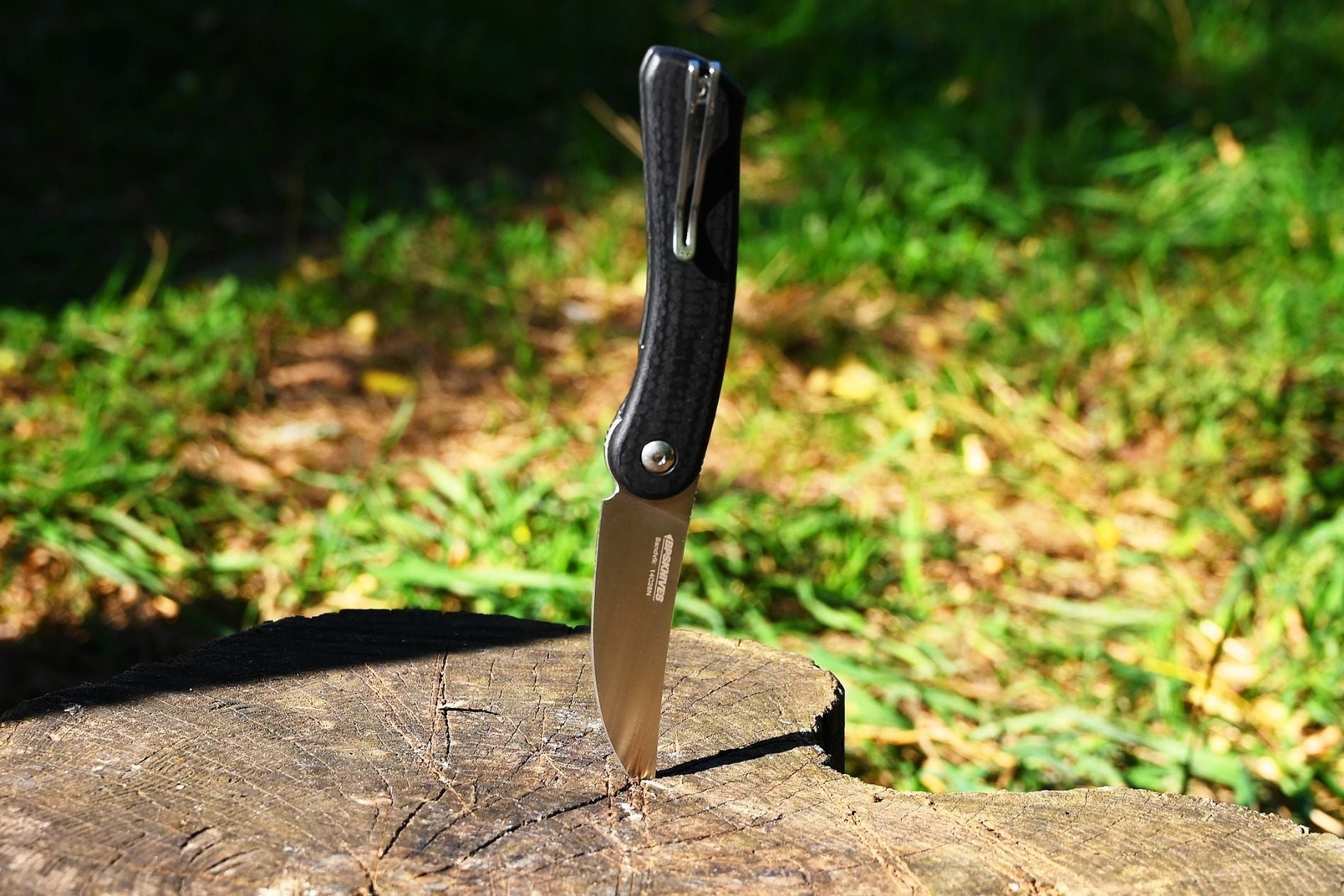
A prime example of this type of knife is our folding knife for winter use Colibri Black (link) — and it’s not called that for nothing. Weighing just 73 grams, with an overall length of 105 mm when closed (185 mm when open), you’ll barely notice it on your belt or backpack — it’s that small and light!
But don’t let its size fool you. Its blade is made from Sandvik 14C28N steel, boasting a hardness of 59-60 HRC. That makes it incredibly strong and reliable, resistant to rust, corrosion, and anything else that comes its way. The stylish G10 handle further protects it from moisture, dirt, and other outdoor challenges. An awesome EDC knife and a perfect companion for your hiking adventures!
Multitools — A Backup Option for Small Tasks Advantages
● Multiple tools in one: Combines a knife blade with pliers, screwdrivers, and other tools for minor repairs and adjustments.
● Space-saving: Replaces several individual tools in your pack.
● Useful for camp maintenance: Ideal for quick fixes, gear adjustments, and small technical tasks.
Disadvantages:
● Limited cutting performance: The blade is usually shorter and less efficient than a dedicated knife.
● Not suited for heavy-duty work: Multitools are designed for precision and convenience, not strength.
● Heavier than a simple knife: Extra tools add weight without significantly improving performance in critical situations.

Key Technical Characteristics of a Knife for Winter Hiking
Now, let’s figure out what the perfect hiking knife should look like!
Types of Steel Suitable for Cold Climates
Choosing the right steel is critical for winter hiking, as low temperatures can affect toughness and edge retention.
- Stainless steel for cold climates: Often preferred in winter due to their corrosion resistance. Snow, moisture, and condensation increase the risk of rust, making stainless steel a practical and low-maintenance option.
- High-toughness steels: Steels with good impact resistance perform better in cold conditions, where brittleness can become an issue.
- Carbon steels: While known for excellent edge retention and ease of sharpening, they require careful maintenance to prevent corrosion in wet winter environments.
In cold climates, a balance between toughness, corrosion resistance, and ease of maintenance is more important than extreme hardness.
Handle Materials: Choosing Between Wood, Synthetics (G-10, Plastic), Composites, Rubber
The handle plays a major role in comfort and safety, especially when hands are cold or gloved.
● Wood: Provides a warm, natural feel and acceptable grip in cold weather, but can absorb moisture and requires more care.
● Synthetics (G-10, plastic): Highly durable, lightweight, and resistant to moisture and temperature changes. G-10 is especially valued for its grip and stability.
● Composites: Designed to combine strength, low weight, and excellent weather resistance.
● Rubber / rubberized materials: Offer superior grip in wet or icy conditions, though they may wear faster over time.
For winter hiking, grip security and moisture resistance matter more than visual appearance.
Optimal Blade Length for Universal Use in Winter Conditions
Blade length directly influences control, efficiency, and overall versatility.
Short blades (under 3 in / 7.5 cm): Excellent control but limited usefulness for food prep and wood-related tasks.
● Medium blades (3–4 in / 7.5–10 cm): The most balanced option for winter hiking, offering both precision and cutting power.
● Long blades (over 4 in / 10 cm): Effective for heavy-duty tasks but less practical for fine control.
A medium-length blade is generally considered the best all-around choice for cold-weather conditions.
Classic Blade Shapes: Drop-Point, Clip-Point, Universal Classics — Control, Strength, and Versatility
Blade geometry plays a key role in how a heavy-duty winter knife performs.
● Drop-point: Strong, controllable, and highly versatile — ideal for winter hiking tasks.
● Clip-point: Excellent for precision work but features a thinner tip that may be less durable in demanding conditions.
● Universal classic shapes: Focus on balanced performance, favoring control and adaptability.
In winter environments, blade shapes that prioritize strength and control are usually the safest choice.
Additional Features: Sheath, Lanyard, Fire-Starter / Ferro Rod, Cord Holes, etc.
Supplementary features can greatly enhance safety and usability.
● Sheath: Should be secure, weather-resistant, and easy to access with gloves.
● Fire-starter / ferro rod compatibility: Adds valuable survival capability in cold conditions.
● Drainage holes and mounting options: Help manage moisture and allow flexible carry configurations.
Thoughtful additional features can transform a knife into a reliable winter hiking and survival tool.
BPS Knives Models Suitable for Winter Hiking
Why struggle, search blindly, or wander around when our craftsmen have created knives specifically for hiking? Everything you need is already here — take a look:
B1 SSHF
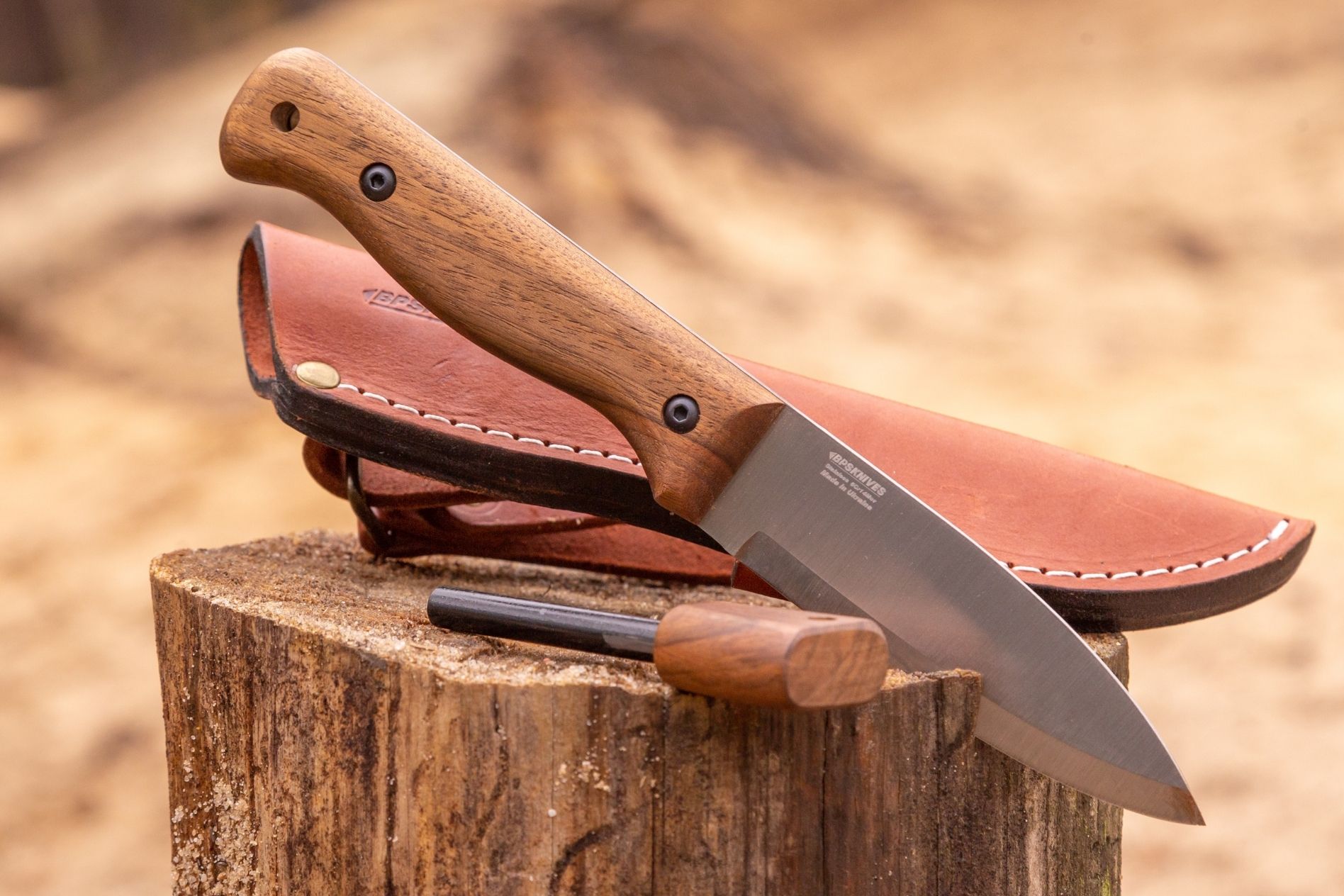
Our knife for winter hiking — the B1 SSHF (link)! Its blade, made of 5Cr14MoV stainless steel with a hardness of 56-58 HRC, features a Scandi grind. The handle is crafted from walnut wood and treated with Danish oil. What does all this mean? It means this knife is highly resistant to corrosion, rust, and anything that might cause them!
At the same time, its strength lets you handle all kinds of hiking and camping tasks — from preparing food to setting up camp and even batonning wood. The knife comes with our top-notch custom leather sheath. And we didn’t stop there: the sheath includes a fire starter, so you can light a fire quickly and efficiently, even in the harshest conditions. With this setup, everything you need for hiking and camping is always within reach.
HK4 SSH
Another one of our creations — the HK4 SSH (link)! Its blade is made from 1066 carbon steel, with a hardness of 57-59 HRC and a Scandi grind. The handle is also crafted from walnut and treated with Danish oil. It’s very similar to the B1 SSHF — like two brothers — but there are key differences.
Unlike the B1 SSHF, the HK4 SSH uses carbon steel instead of stainless. This means the blade is easier to sharpen and excels at cutting wood. 1066 carbon steel performs exceptionally well in cold weather and can handle heavy-duty tasks, which is especially important in winter. While it requires minimal maintenance, in return you get a reliable, hard-working knife for hiking and camping in harsh, cold conditions.

What These Models Have in Common — and Why They Are Worth Considering for Winter Use
Both models share the same functional philosophy: fixed blades with Scandi grind, designed for reliable performance during hiking and camping, including winter conditions. This grind excels at wood processing, is easy to maintain in the field, and remains predictable when working in gloves or cold weather.
Both winter survival knives feature walnut handles treated with Danish oil for a secure grip, and both come with durable leather sheaths suited for low temperatures. Together, these shared design choices — combined with two distinct steel options — make the models well-balanced and practical tools for winter hiking, depending on whether you prioritize corrosion resistance or maximum cutting performance.
Conclusion
The rest is up to you! Choose the HK4 SSH or B1 SSHF — or even both — pack your backpack, and set off for adventure. And if these knives aren’t quite your style, don’t worry: in our online store, you’ll definitely find the blade of your dreams. We have knives for the kitchen, hunting, fishing, camping, hiking, and even wilderness survival. That’s all for now — see you soon, and happy adventures until next time!